
How Data Analytics Can Help Teachers Track and Improve Student Performance
When Mrs. Radhika, a high school math teacher in Bengaluru, noticed that one of her brightest students, Arjun, had suddenly started scoring lower on weekly quizzes, she was puzzled. Arjun was attentive in class, asked good questions, and always submitted his homework on time. Something didn’t add up. Instead of relying only on intuition, she decided to check the data available on her school’s learning management system.
To her surprise, the analytics revealed a pattern—Arjun’s performance dropped significantly on questions that required multi-step problem-solving, though he was still strong with direct, formulabased questions. Armed with this insight, Mrs. Radhika gave Arjun targeted practice on logical reasoning and multi-step word problems. Within a few weeks, his performance improved dramatically.
This is the power of data analytics in education—it turns scattered information into clear insights, helping teachers take precise actions that truly impact student success.
Why Data Analytics in Education?
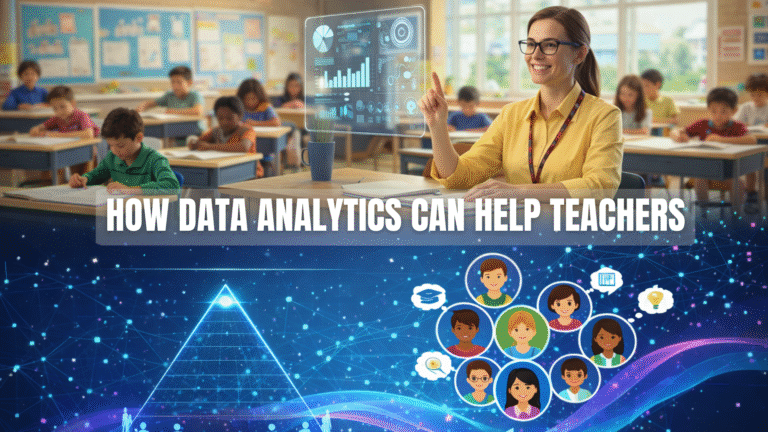
At its core, data analytics in education refers to collecting, analyzing, and interpreting studentrelated information like attendance, grades, participation, and behavior—to better understand learning progress. Instead of relying solely on end-of-term exam results or even CCA processes, teachers can use real-time insights to monitor student performance, address issues early, and design strategies that improve outcomes.
How Teachers Can Practically Implement Data Analytics
For schools, implementing data analytics doesn’t have to be overwhelming—it starts with integration. Many institutions already use ERP (Enterprise Resource Planning) software for attendance, grading, and administration. By integrating analytics engines into these ERP systems, schools can automatically capture and process student data in real time. Thus, huge amounts of student data are being generated every day. Teachers and administrators can then run customized queries—for example, generating reports on students who have shown a decline in weekly test scores or correlating attendance with performance. Advanced setups go a step further by using AIpowered analytics engines that not only summarize past performance but also predict future outcomes—such as identifying which students may be at risk of underperforming in upcoming exams. These predictive insights allow teachers to create timely interventions, design targeted remedial programs, and personalize teaching at scale, turning data into a genuine driver of learning success.
Benefits of Using Data Analytics for Teachers
-
1. Early Identification of Struggling Students
Analytics can highlight performance drops, like in Arjun’s case, enabling teachers to step in before problems escalate. This proactive approach reduces dropout risks and helps students regain confidence. -
2. Personalized Learning Pathways
Not all students learn in the same way. By analyzing data on homework, quiz results, and participation, teachers can understand individual learning styles and create customized lesson plans—ensuring that fast learners are challenged while slower learners get the support they need. -
3. Enhanced Classroom Engagement
By examining which activities generate the most participation, teachers can refine lessons to make them more engaging. For instance, data might show that students perform better after interactive group sessions than traditional lectures. -
4. Holistic and Fair Assessments
Instead of depending solely on exam scores, analytics integrates multiple factors like assignments, projects, and participation, giving a well-rounded view of student performance. -
5. Stronger Communication with Parents
Parents appreciate clear insights into their child’s learning journey. Data-driven reports allow teachers to share specific progress patterns and actionable suggestions, strengthening home-school collaboration. -
6. Evidence-Based Teaching Strategies
Teachers often experiment with new teaching methods. With analytics, they can measure effectiveness by comparing student performance before and after a new strategy is introduced— making instructional improvements more scientific and reliable.
Practical Examples of Data Analytics in the Classroom
- Attendance Patterns : Linking absenteeism trends with grades to identify at-risk students.
- Predictive Analytics : Using AI tools to forecast whether students are likely to pass or need extra help.
- Adaptive Platforms : Tools like Khan Academy adjust exercise difficulty based on realtime performance.
- Instant Feedback : Online quizzes highlight which concepts are well understood and which require reteaching.
Challenges to Consider
While powerful, data analytics comes with certain hurdles:
- 1. Data Privacy – Safeguarding student information is crucial.
- 2. Teacher Training – Not all teachers are skilled in interpreting data, requiring proper training.
- 3. Balanced Use – Data should guide decisions, not replace human intuition and empathy.
- 4. Resource Gaps – High-end analytics platforms can be costly for schools with limited budgets.
End note for the teachers
Just as Mrs. Radhika helped Arjun get back on track, teachers everywhere can harness data analytics to unlock student potential. It is not about replacing the teacher’s instinct but enhancing it with evidence-based insights.
By identifying struggling learners early, personalizing education, engaging classrooms, and improving communication with parents, data analytics is transforming the way learning happens. Ultimately, it empowers teachers to do what they do best—help students succeed.
About the Author:
- Dr. Anoop Mathew.
The author is a consultant to leading EdTech companies and prominent educational groups across India and the Middle East.